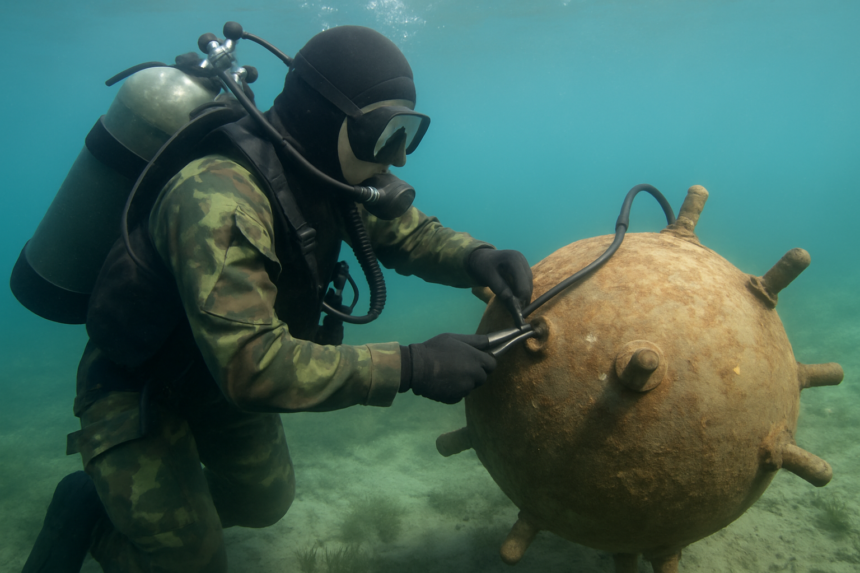
The introduction of advanced autonomous systems is revolutionizing mine countermeasure operations in the Strait of Hormuz, a maritime chokepoint critical for global trade. The presence of underwater mines has intensified uncertainty across the maritime industry, resulting in increased insurance costs and delayed shipments for operators navigating these treacherous waters.
The Mine Threat
In the Strait of Hormuz, even a few strategically placed mines can significantly disrupt maritime activities. The threat extends beyond immediate damage; the mere presence of these munitions can inflate shipping costs, alter routes, and consume naval resources necessary for clearance operations. As global shipping relies heavily on this vital waterway, addressing these challenges has become increasingly urgent.
Innovative Solutions
Greensea IQ has been at the forefront of developing autonomous maritime technology aimed at enhancing safety during mine clearance operations. Their Bayonet underwater crawler represents an important advancement, being the only commercially available robot capable of conducting mine countermeasure missions from the shoreline to the seabed. With over 20 years of experience, Greensea IQ has tailored its technology to meet the complex demands of modern maritime operations, particularly in collaboration with the U.S. Navy since 2014.


Modern mines have become more sophisticated, which makes traditional detection methods increasingly inadequate. Many mines can be triggered by disturbances, camouflaged in complex underwater terrains, or buried beneath sediment. This growing complexity necessitates the deployment of specialized sensors and autonomous systems to ensure accurate mine detection and neutralization.
The geographical conditions of the Strait complicate clearance operations further. The narrow shipping channel is characterized by strong currents, shallow waters, and significant underwater debris. The cluttered terrain can obscure potential mine threats, creating a pressing need for enhanced technological solutions that can operate efficiently in these challenging environments.
Operational Impact
Traditionally, mine clearance has relied heavily on divers—a method that faces limitations regarding time, environmental conditions, and operational safety. Dennis Doan, EOD Product Manager at Greensea IQ and a retired U.S. Navy EOD Senior Chief, emphasizes that divers should be the last resort in minefield scenarios. The Strait of Hormuz presents numerous dangers, making autonomous systems an essential tool for ensuring the safety of maritime operations.
By incorporating advanced technology, Greensea IQ’s Bayonet AUGV aims to enhance the operational readiness necessary for these high-risk clearance missions. The transition to autonomous systems not only increases the speed and efficiency of clearance operations but also decreases the risk to human operators, particularly in some of the most perilous environments globally.
The Operational Read
The ongoing development of autonomous systems like the Bayonet AUGV significantly reshapes the landscape of maritime mine countermeasures. For operators and shipping companies, a successful implementation of these technologies will mitigate the risks associated with mine threats in congested waterways. In addition, as insurers adjust their risk assessments in response to increasing mine incidents, the ability to conduct rapid, reliable clearance operations will become a key factor influencing shipping rates and overall trade volatility. Stakeholders should closely monitor developments in autonomous mine clearance technologies, as they could redefine operational norms and risk management practices in maritime operations.