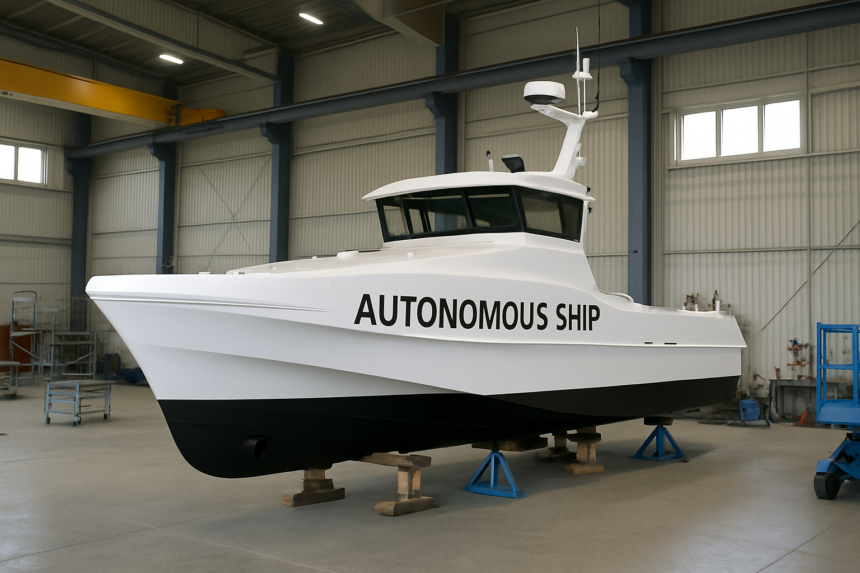
Saronic and South Korea’s Samsung Heavy Industries (SHI) have entered into a strategic partnership aimed at accelerating the development of autonomous maritime systems. Announced Thursday during the launch of the Korea–U.S. Shipbuilding Partnership Center (KUSPC) in Washington, D.C., the collaboration combines Saronic’s expertise in autonomous surface vessels with SHI’s extensive experience in commercial shipbuilding and advanced manufacturing.
The Partnership Details
The agreement is designed to enhance capabilities for creating autonomy-capable vessels for government and commercial customers, while also enabling exploration of AI-driven digital technologies, robotics-based production automation, and innovative shipyard manufacturing processes. According to Saronic’s co-founder and CEO, Dino Mavrookas, reinforcing America’s maritime strength necessitates world-class technology coupled with the industrial capacity to produce it domestically. He stated, “Together, we will focus on accelerating the reindustrialization of American shipbuilding, training the workforce of the future, and delivering differentiated, autonomy-capable vessels for both government and commercial applications.”
Impact on U.S. Shipbuilding
The announcement comes shortly after Saronic selected Brownsville, Texas, as the location for its proposed $3 billion Port Alpha autonomous shipyard, a significant project expected to enhance the U.S. capacity to construct large autonomous vessels. Planned for an initial 835-acre site at the Port of Brownsville, construction is anticipated to commence later this year with an opening slated for 2028. This facility aims to support vessels exceeding 1,200 feet in length and has the potential to create up to 10,000 direct jobs over the next decade.

Technological Integration
The collaboration extends to the production infrastructure, with Saronic and SHI exploring robotics-based process automation across Saronic’s shipyards, including the facility in Texas and its existing shipyard in Franklin, Louisiana. An additional investment of $300 million has been earmarked for expanding production at the Louisiana yard following Saronic’s acquisition of Gulf Craft. This partnership underscores the increasing U.S. commitment to fortifying the domestic shipbuilding landscape by merging American autonomous systems technology with allied manufacturing strengths.
The Operational Read
This partnership illustrates a pivotal shift in the U.S. shipbuilding sector, aligning technological advancements with significant investments aimed at revitalizing domestic capabilities. The emphasis on developing autonomy-capable vessels responds to a growing global demand, particularly in defense applications. It is crucial for operators and stakeholders to monitor advancements in the integration of AI and robotics in shipbuilding processes, as these innovations may set new industry standards. The outcome of the Port Alpha project will be key in assessing the U.S.’s ability to compete with established international shipbuilders, while potentially reshaping naval operations and defense strategies in the region.