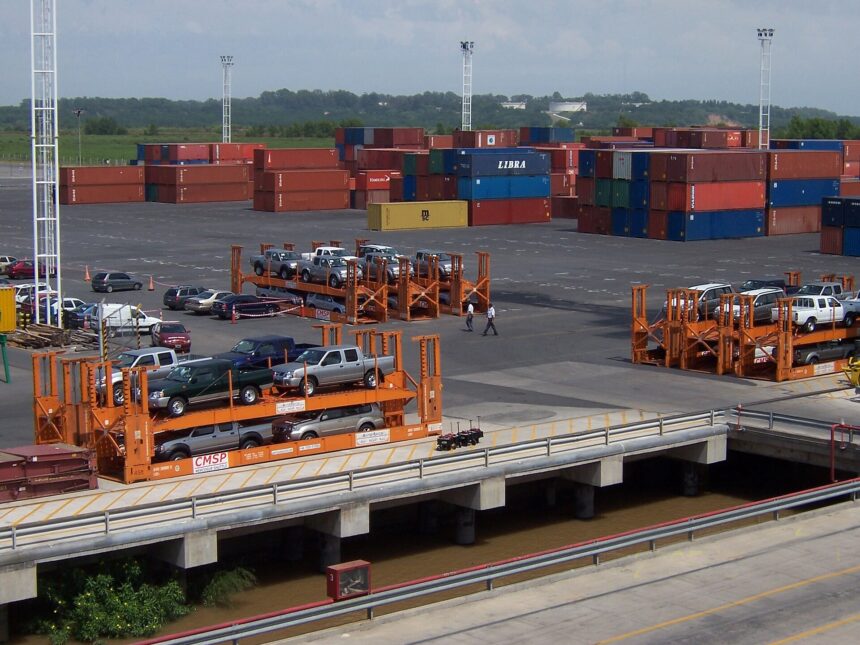
The Georgia Ports Authority is significantly enhancing the automotive shipping capabilities at the Port of Brunswick in response to the booming manufacturing sector. This development comes amidst an influx of global automakers establishing production facilities in the state, solidifying Georgia’s status as a major hub for vehicle production and logistics.
Expansion Details
At the annual State of the Port of Brunswick event held on Tuesday, port officials outlined plans to expand automotive shipping infrastructure, which is vital for meeting surging demand for roll-on/roll-off (RoRo) shipping. The authority has reported that Brunswick is a leader in automotive imports and exports, with a remarkable 277% growth in activity over the last decade.
Currently, the port operates three RoRo berths at Colonel’s Island, having accommodated 50 vessels just in October. A fourth berth, which is now 60% complete, is slated to open in December 2027, enhancing capacity to handle the latest generations of vehicle carriers capable of transporting over 10,800 car equivalent units (CEUs).


Impact on the Automotive Sector
This expansion is expected to improve vessel turnaround times while providing much-needed room for future increases in vehicle imports and exports. Georgia Ports Authority CEO Griff Lynch emphasized that these developments are creating opportunities for business growth and enhancing supply chain competitiveness at multiple levels, which in turn generates new job opportunities across the state.
The automotive manufacturing landscape in Georgia is burgeoning, with Hyundai Motor Group’s new Metaplant near Savannah expected to create 8,500 jobs by 2031 and attracting 22 suppliers. Furthermore, Kia has had a manufacturing presence in West Point since 2009, while Rivian’s $5 billion facility at Stanton Springs North is projected to create 7,500 permanent jobs by 2030. Audi has also announced plans for a new $4 billion manufacturing plant near Macon, with construction anticipated to begin in 2027.
Broader Logistics Growth
Besides finished vehicles, the Port of Brunswick is also expanding its role in heavy equipment logistics, including construction and farm machinery. Meanwhile, the Port of Savannah complements Brunswick by serving as a vital gateway for containerized automotive parts, handling around 40 vessel calls weekly, along with 15,000 daily truck transactions and 42 double-stack trains each week via its Mason Mega Rail facility.
The Georgia Ports Authority’s nearly $5 billion infrastructure improvement plan also includes additional container ship berths in Savannah, reinforcing the region’s growing significance in the automotive manufacturing supply chain.
Behind the Headline
The expansion of the Port of Brunswick’s automotive shipping capacity demonstrates a proactive approach to accommodate the rapid growth in automotive manufacturing in Georgia. As new production facilities spring up, the logistical demands on ports are evolving. This necessitates strategic infrastructure improvements to ensure swift operations and support increased cargo volumes. Operators and stakeholders must now monitor ongoing developments in the automotive sector, including shifts in shipping patterns and transportation needs, which will ultimately influence supply chain efficiency and competitiveness within the industry.