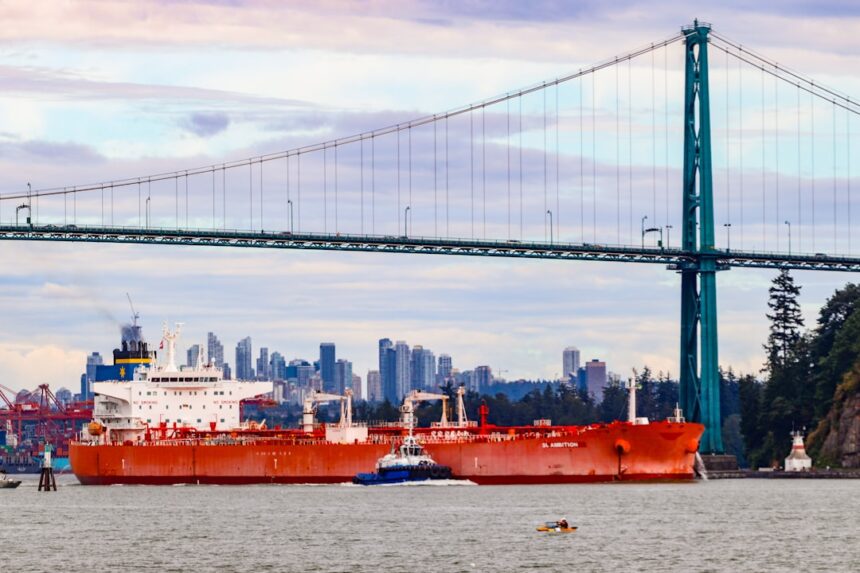
On September 10, Aframax freight rates for the Vancouver-China route reached an unprecedented level of $7.5 million, marking a significant peak for this benchmark as shipowners capitalized on tight tonnage and robust demand amid a shifting market landscape.
Market Dynamics
The surge in rates can be attributed to shipowners reassessing earnings from Vancouver against a burgeoning demand in the Far East and Arab Gulf. As one shipbroker observed, “Blood in the water and the owners are sharks.” The market dynamics shifted as the benchmark 80,000 metric ton (mt) rate held steady at approximately $3.1 million throughout August and early September before experiencing this dramatic upward turn.
The recent activities surrounding ExxonMobil’s decision to open a Vancouver-East cargo loading at the end of September played a pivotal role in this rate increase. Reports indicate that the charterer arrived “a touch late to market,” prompting ExxonMobil to secure a rate of $7.5 million for the trans-Pacific voyage.

US Gulf Coast Activity
In the US Gulf Coast, significant activity was also noted on September 10, with six transatlantic fixtures reported. Eni repeated a level of 310 Worldscale points, followed by Sinochem booking a Monza loading for September 25 at w365. Other operators, including ATMI and Equinor, confirmed bookings at w400, accompanied by notable demurrage rates.
As rates continued to rise, BP secured an end-September loader at w425, with $185,000 daily demurrage, while Equinor booked the Lake Stars for the third decade of September at w450. The benchmark 70,000 mt US Gulf Coast-UK Continent/Mediterranean route surged to w450, its highest assessment since April 28, driven by increased demand and aggressive negotiations.
Geopolitical Influences
The market has experienced heightened volatility linked to escalating tensions in the Gulf of Oman, where the US Central Command reported the destruction of five Iranian crude tankers on September 8. This incident was followed by Iran’s claims of maritime assaults on US vessels and oil tankers. These developments are expected to further impact freight rates, as shipowners remain on high alert amidst the geopolitical climate.
Behind the Headline
The current surge in Aframax rates underscores the critical interplay between supply, demand, and geopolitical factors in the maritime shipping industry. With owners now negotiating from a position of strength and attention turning to the potential for further increases, operators must remain vigilant. The recent disruptions in the Gulf region not only influence immediate freight rates but also serve as a warning sign for future operations. As oil demand remains strong and tensions persist, monitoring capacity and market sentiment will be crucial for all stakeholders involved.