The waiting period nobody warns you about
Everyone claps when you graduate.
Four years. Eight semesters. The photos, the gowns, the relief on your parents’ faces. Then you go home, and the part nobody warned you about begins.
The waiting.


I passed out with seven friends from the same company, and one more from a different college. Same degree, same dream, roughly the same starting line. But when we talk now, we’re all living completely different versions of the same story. Let me start with mine, because mine is the easy one.
My sister was already in shipping. So when I came home and tried to explain that there’s this thing called a waiting period, that you don’t walk off the stage and straight onto a ship, my parents already knew. They’d seen it before. That made me lucky, and I didn’t realise how lucky until I started hearing everyone else.
Because most families have nothing to compare it to. A son or a daughter finishes an expensive degree, comes home, and then just sits. For some of my friends the wait for a first ship is past eight months now. For one of them it’s closer to a year. A couple haven’t even finished their documentation yet, and if you’ve never done it, you really have no idea how much of it there is.
Let me take you through only the paperwork, because outside this line of work almost nobody knows it exists.
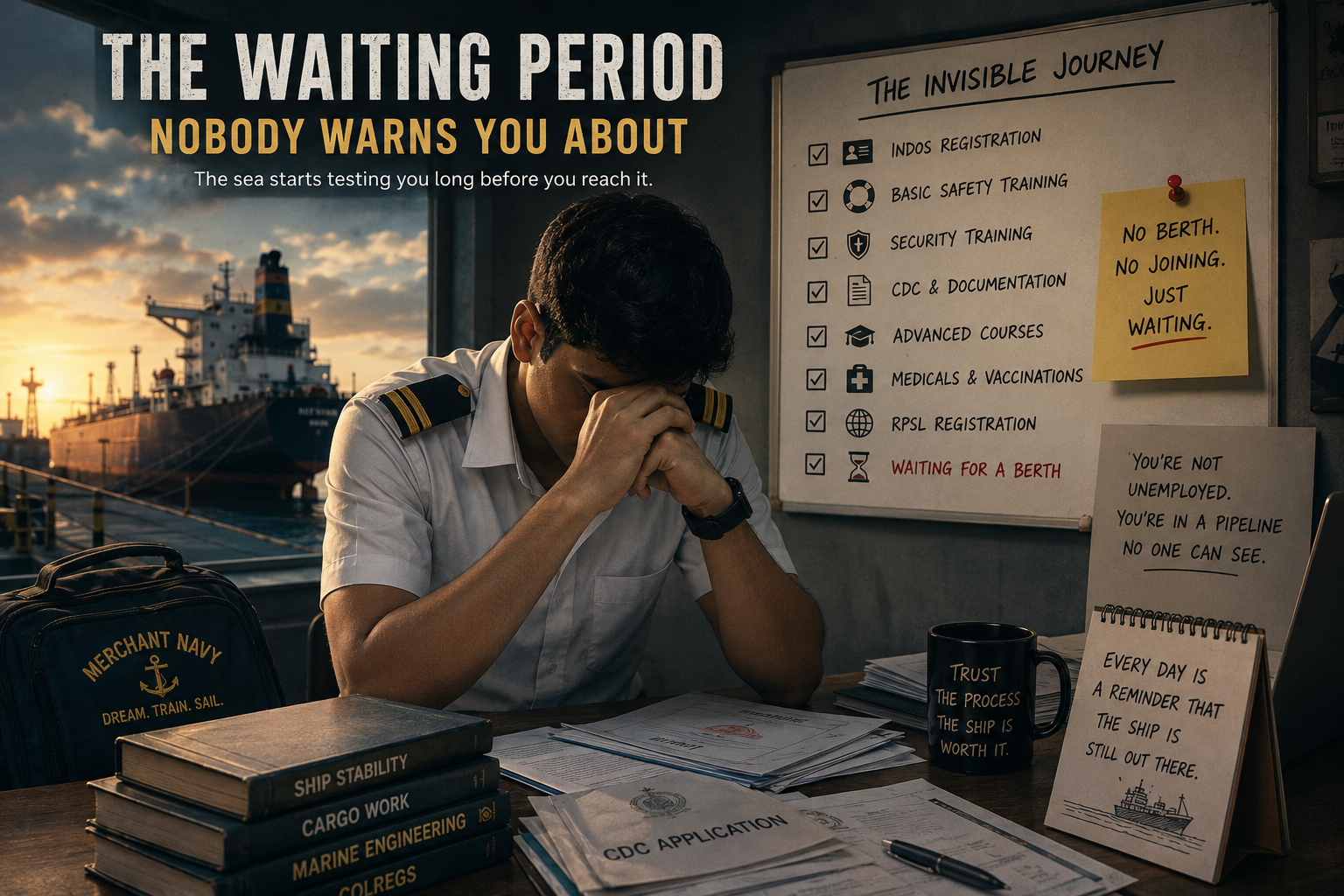
It starts with your INDoS number, the seafarer registry everything else is built on. Then every single detail has to match your passport exactly, or you go back, fix it, and wait again. Then Basic Safety Training: survival, firefighting, first aid, the safety and social responsibility course. Then security training on top of that. Then you wait for results. Then you wait again for the certificates to actually come through. Then you apply for your CDC, the seaman’s book that’s basically your identity at sea, and you wait for that one too.
And here’s what quietly finishes people off. The day you finally hold your CDC in your hand, you’re not even ten percent done.
If your company is putting you on a tanker or a gas carrier, a whole new pile of courses begins. Oil and chemical tanker operations. Gas cargo operations. The dangerous cargo endorsement that lets you sail on those ships at all. Each one is another booking, another fee, another queue. You sign up with an RPSL agency, because legally you can’t even fly out to join a ship without being registered with one. Then the medicals, the vaccinations, the yellow fever card. The list just keeps opening up in front of you.
None of this is the part anyone romanticises. None of it makes it onto anyone’s feed. But this is the actual gangway between a degree and a deck, and you cross it alone, mostly standing in queues and refreshing an inbox.
And then there’s the medical, which can quietly undo the whole thing in a single morning.
You can clear four years of college, pass every paper, finish every course, and still get stopped at an eye chart. Colour blindness is a flat disqualification. No appeal, no second try. Your eyesight has to sit inside strict limits. There are standards for weight, for squint, for conditions you might not even know you’re carrying. People who’ve already spent lakhs on this career walk in and find out the door is shut, and there’s nothing waiting on the other side of that. I’ve got a company lined up and I still felt my stomach drop on the way into mine. You don’t stop being nervous about that test until the paper is signed.
Then there’s the part no course prepares you for at all. The empty time.
Picture living four years inside a place that runs on a bell. Muster, classes, drills, deadlines, every hour decided for you. And then, almost overnight, nothing. No schedule. No next thing. Just a phone you keep checking and one question you can’t answer, which is when. You spend years being built for routine, and then you’re handed only waiting, and that does something to your head that nobody really warns you about.
But the heaviest part isn’t any of that. It’s how the waiting looks from the outside.
To the people around you, you’re just unemployed. You finished your course, you told the whole family you had a job, and now you’re home every single day with no ship and no joining date. I’ve watched this happen to friends. Relatives start wondering out loud whether the job was ever real. In some houses the parents genuinely start to believe their own child lied to them, that the job was a story he made up to cover the fact that he’s sitting at home doing nothing. It isn’t cruelty. It’s that people outside this industry know almost nothing about how it works, so they fill the silence with the worst version they can think of.
You’re not unemployed. You’re stuck inside a pipeline that nobody around you can see. But try explaining a berth shortage to a neighbour who only wants to know why you haven’t left yet.
And it really is a shortage. India has crossed three hundred thousand seafarers and supplies around one in eight of the world’s crew, and the country keeps saying it wants that share higher. The catch is that most of the demand sits at the top, at the senior ranks. Down at the bottom, where the fresh cadets and trainee engineers are standing, there are far more of us than there are berths to put us on. So we wait. Most of us wait honestly. The ones who get desperate turn into easy money for the wrong people.
This is where it turns ugly. By law, under the Maritime Labour Convention and DG Shipping’s own rules, nobody is allowed to charge you for a berth or for your onboard training. It’s illegal. And still the ads are everywhere, promising a hundred percent placement, promising a ship if you just pay a little extra, asking for your documents and your bank details. The people who fall for it aren’t stupid. They’re tired, they’re months deep into waiting, their family is asking questions every day, and finally somebody tells them yes. That’s how honest people lose lakhs they never had to lose.
Then comes the part nobody likes to put numbers on. The money.
A lot of us got here on loans. Some friends funded their own training, eight to fifteen lakh out of their own pocket, and are now hunting for a berth with all of that already gone. And a loan doesn’t care that you’re waiting. The moratorium runs out on its own clock, the course plus six months or a year, and then the EMIs begin whether or not you’ve earned a single rupee at sea. Repayment starts before the income does. And when you finally sail and the first real money comes in, it’s already promised to something: clear the loan, then start saving for the next set of exams, the certificate that turns a trainee into an officer. That first salary isn’t a celebration. It’s a balancing act you waited months just to be allowed to begin.
I’m writing this from the lucky side of all of it. I have a company, a joining date on the way, and a sister who explained the whole thing to my parents before I ever had to. But I keep thinking about the other versions of this I know by name. The friends still refreshing an inbox. Still queuing for one more course. Still sitting at a dinner table explaining that no, they didn’t lie, the ship is coming.
So if you know someone caught in this stretch, graduated and qualified and somehow still at home, understand what they’re actually doing. They’re not sitting idle. They’re crossing the invisible part of this profession, the part with no uniform, no audience, and no proof you’re moving forward except a folder of certificates that keeps getting thicker.
The sea starts testing you long before you ever reach it.
And learning to wait through all of it, without losing your nerve, your savings, or your belief that the ship is even real, might just be the first real thing this life teaches you.