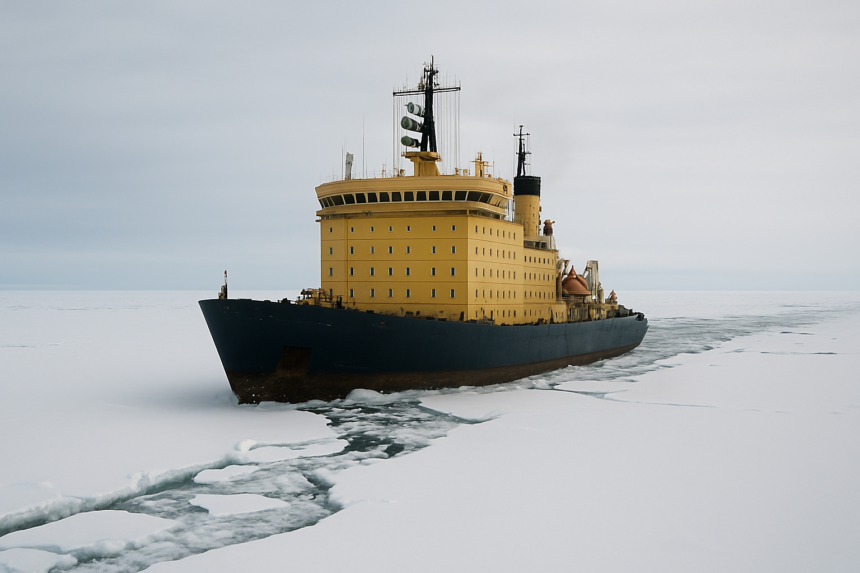
South Korea’s icebreaker Araon has commenced its 17th Arctic expedition, focusing on gathering essential data to support future Arctic shipping routes in light of changing environmental conditions. Operated by the Korea Polar Research Institute (KOPRI), the 7,500-ton vessel departed from Incheon on Friday for a mission expected to last approximately three months.
The Expedition’s Objectives
This year’s expedition aims to perform extensive climate, oceanographic, and ecosystem research across Arctic waters, particularly around Alaska and the Chukchi and Beaufort seas. Researchers will deploy autonomous observation equipment to monitor sea ice and navigation conditions that are vital for commercial shipping interests. According to KOPRI, this initiative is critical as shipping activity is poised to expand due to increasingly longer ice-free periods which alter historical navigation patterns.
KOPRI President Shin Hyeong-cheol emphasized the importance of documenting the Arctic’s changing environment, stating, “This expedition is a meaningful one that documents the Arctic, the front line of climate change, while simultaneously preparing for the era of the Arctic shipping route.” The data collected could significantly bolster South Korea’s scientific expertise in Arctic navigation and environmental assessment.

Strategic Shipping Initiatives
The Araon’s departure coincides with South Korea’s preparations for its inaugural trial container shipping voyage through the Arctic to Europe, planned for later this summer. This trial aims to evaluate the feasibility of the Northern Sea Route in shortening transit times between Northeast Asia and European markets during seasonal navigation windows.
Geopolitical dynamics and shifting maritime trends indicate increasing strategic value for South Korea as it enhances its polar research capabilities while simultaneously developing ice-class vessels through its robust shipbuilding industry. In a recent milestone, HD Hyundai Heavy Industries has secured a contract valued at $348.9 million to construct a next-generation icebreaker for Sweden, highlighting the growing international demand for advanced icebreaking technology.
On a domestic level, South Korea is advancing the construction of its own state-of-the-art heavy icebreaking research vessel, with Hanwha Ocean awarded the contract in 2025. This new vessel, expected to enter service around 2030, will significantly enhance South Korea’s polar research initiatives beyond the Araon, which has been operational since 2009.
Behind the Headline
The dispatch of the Araon underscores a proactive approach by South Korea to harness emerging opportunities in Arctic shipping amidst changing climate conditions. By enhancing its research capabilities and investing in ice-class vessel technology, South Korea is positioning itself strategically to gain from the gradual opening of the Northern Sea Route. Operators should monitor this space closely as geopolitical and environmental factors interplay, potentially leading to regulatory changes that could impact shipping strategies in Arctic waters. Future engagement will involve balancing operational readiness against unforeseen ice conditions and infrastructural limitations, presenting both opportunities and challenges for maritime logistics in the polar regions.