

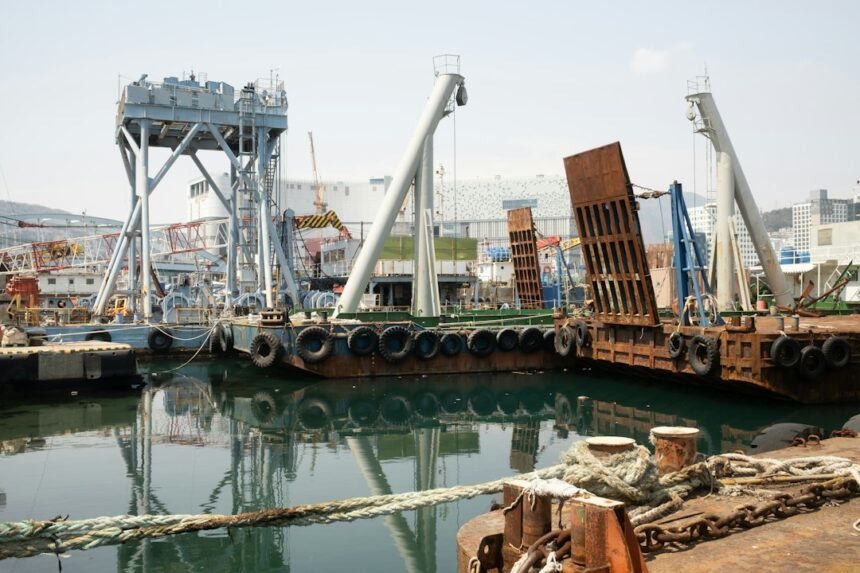
Hanwha Ocean is positioning itself as a pivotal player in the revival of U.S. shipbuilding, with substantial investments aimed at enhancing production capabilities amid challenges posed by the existing industry landscape. The South Korean firm’s recent acquisition of Philly Shipyard is aligning with the Trump administration’s vision for a revitalized maritime sector, crucial for diminishing reliance on China’s dominance in global shipbuilding.
The Investment Landscape
The Wall Street Journal reported on October 25 that Hanwha has invested $350 million in improving facilities at Philly Shipyard since acquiring it in December 2024. The firm plans to allocate several billion dollars more as it seeks to modernize operations to support U.S. Navy projects. Currently, the U.S. accounts for less than 1% of international shipbuilding output, which underscores the challenge of rebuilding capacity through domestic means alone.
The South Korean government has pledged a substantial $150 billion toward this sector, reinforcing the collaborative efforts between Hanwha and U.S. interests. Hanwha’s advances in automation and robotics at its Geoje shipyard highlight the potential for introducing innovative technologies into the U.S. shipbuilding market.

Strategic Direction and Challenges
In its strategic roadmap, Hanwha is evolving Philly Shipyard’s capabilities to encompass combat shipbuilding by 2028, moving beyond its current auxiliary vessel construction focus. Recent achievements include securing a subcontract for the initial design of the U.S. Navy’s next-generation logistics vessel and a contract for specialized auxiliary vessels tied to missile defense initiatives. Moreover, Hanwha is considering further acquisitions, such as a nonbinding offer exceeding $1 billion for Austal USA’s shipyard located in Mobile, Alabama.
Despite these advancements, Hanwha encounters significant barriers. Philly Shipyard grapples with elevated production costs, subcontractor shortages, and constrained physical space, which limit output scalability. Furthermore, the complexity of reestablishing a robust supply chain after decades of decline in the U.S. shipbuilding industry necessitates considerable time and investment.
Political uncertainty poses an additional risk factor, as divergent positions regarding funding for overseas-built vessels in Congress create an unstable environment for defense spending. Without clearer long-term demand signals from the U.S. Department of Defense, the likelihood of sustained investment from allied firms like Hanwha may be jeopardized.
Behind the Headline
The evolving dynamics of U.S. shipbuilding significantly hinge on partnerships like that of Hanwha Ocean. By infusing capital and advanced technology, there is potential to breathe new life into what has been a stagnating industry. However, the interplay of operational challenges, such as production costs and subcontractor shortages, must be addressed to fulfill projected ambitions. The influence of broader political narratives and legislative actions will also be critical in shaping supply chain stability and long-term operational viability. Observers should closely monitor contract awards and funding shifts in U.S. defense legislation as indicators of the industry’s trajectory.